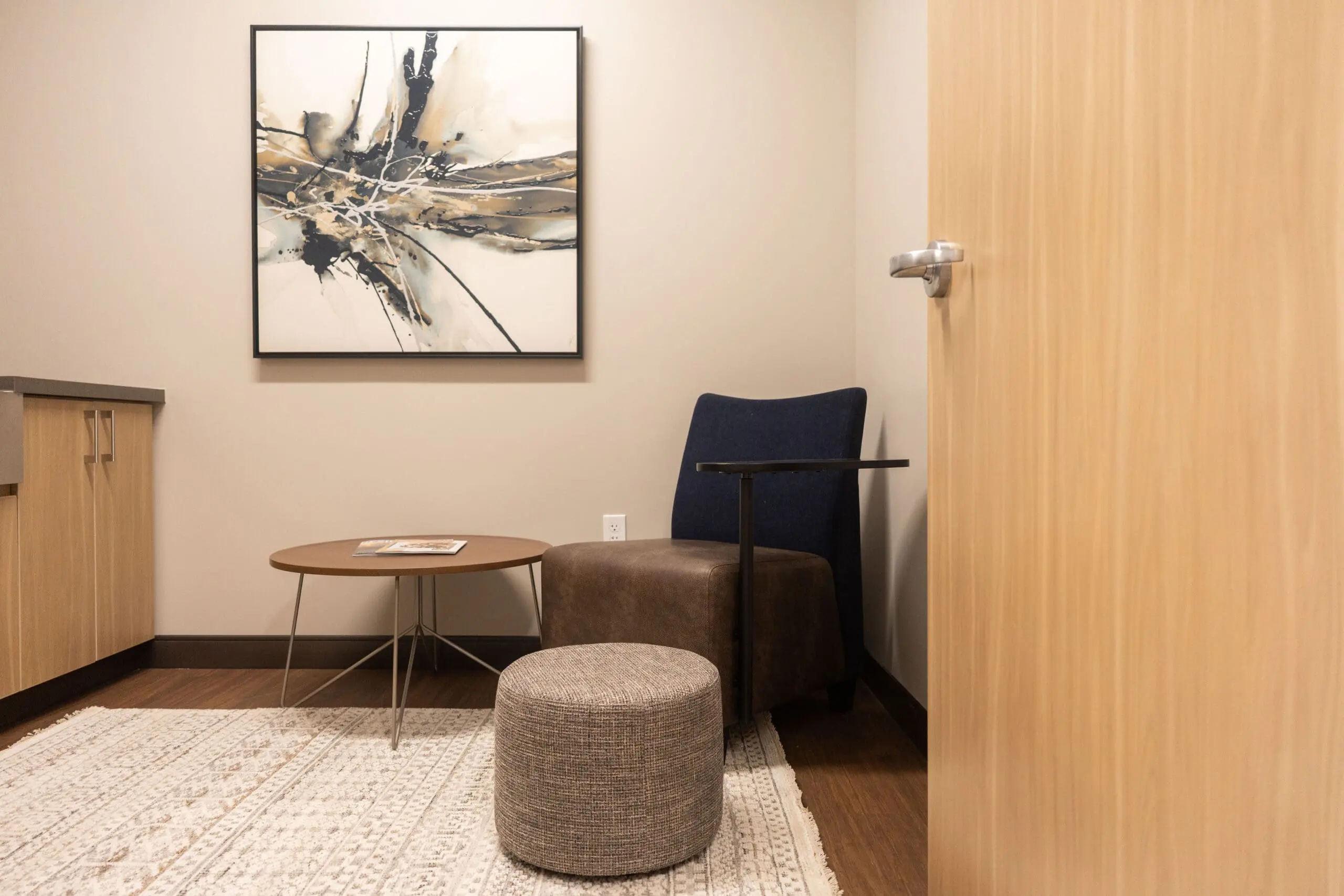
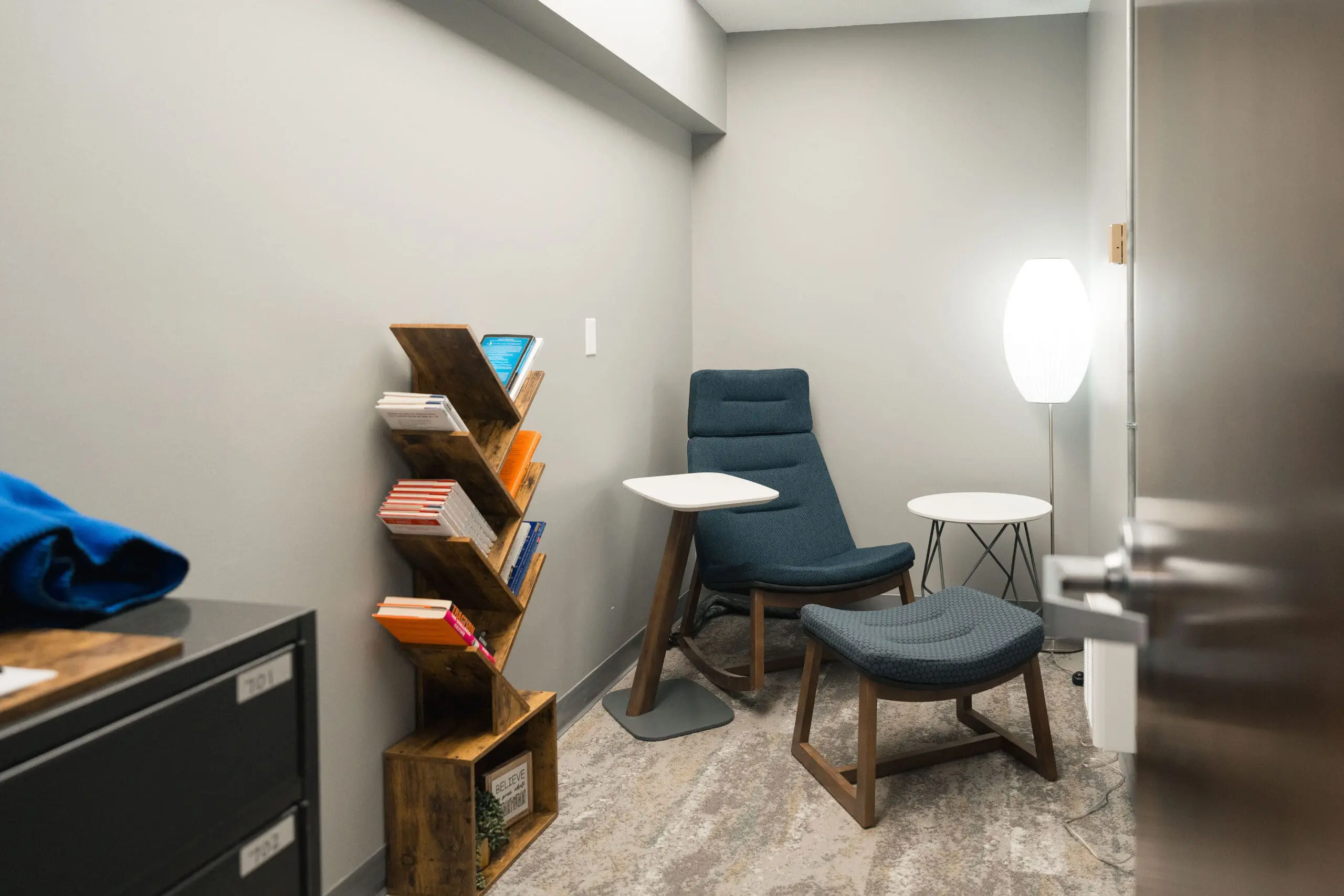
As part of their work at InterOffice, the Workspace Experts are becoming more and more familiar with the needs of and approaches to making respite rooms.
“It’s about finding out how people want to use them,” Jolynn said. “We ask what employers envision people doing in this room. For example, do they want to recline in a chair, rock in a chair, or sit in a stationary chair?”
Using that information, the space is crafted to achieve those ideas. Each respite room is highly customizable. While one office may need lush carpets and moody lamps, another may want natural light and light wooden finishes. Luckily, with InterOffice’s 3D modeling offerings, clients are able to see what they’re getting long before an order is placed.
InterOffice can design rooms to be an extension of the organization’s brand if folks are interested in continuity within their space. However, clients aren’t limited by those brand guidelines. These rooms can feel like extensions of the brand and the company, or they can feel like mini-escapes while still fitting cohesively into the established space. It’s the finishing touches that InterOffice makes that keep the spaces connected.
Healthy and Happy Employees
Further, investing in a respite room can help retain employees while helping them maintain their mental and physical health. Whether it’s a quick cat nap or a comfortable spot to pump or a private space, these rooms provide employees opportunities and spaces to handle the more human aspects of life.
“People can use the respite room however they’d like to,” Jolynn said. “It’s nice for people to have a space to go.”
Respite spaces are an investment in the workforce. Employees seek out excellent amenities, so these spaces quickly become a high-return investment, helping companies retain current and draw in new employees.
“Having an individual space like a respite room can offer employees a personal space to recharge during their workday,” Jolynn said.
The furniture pieces used in these respite rooms are also a big draw for employees. Pre-pandemic, many folks were used to sterile, stale office amenities that didn’t offer much in terms of comfort or respite. Organizations are making an effort post-pandemic to create more comfortable spaces, aiming to draw employees back from their work-from-home setups. The industry is calling it “resimercial,” a combo of residential and commercial approaches, using furniture and decor to create comfort with durability and professionalism.
“It makes the space more home-like,” Jolynn continued. “And it gives people the opportunity to feel comfortable enough to decompress.”